

Rapid Iteration in HME Software: Why It Matters in DME HME
Payer rules change constantly. Here is why the speed at which your DME HME billing software ships fixes decides how fast your claims get paid.
Payer rules, denials, and claim requirements for DME HME billing change constantly across every U.S. payer. Rapid software iteration matters because static systems create compliance gaps and slow cash collection. BFLOW's AI-assisted, human-checked platform updates intake, billing, and RCM workflows continuously, giving DME HME providers direct access to the team building fixes: no ticket queues, no handoffs.
Why Does Software Speed Matter for DME HME Billing?
Speed determines whether a DME or HME claim gets paid on time or stalls in a backlog. Billing software functions as the system that carries an order from intake through to a paid claim. A delay anywhere in that chain ripples across the entire revenue cycle. DME billing carries more complexity than standard medical billing. That complexity raises the stakes for how quickly a platform can adapt to new payer rules, documentation requirements, or coding updates.
Claims for items like wheelchairs or oxygen concentrators may depend on different documentation requirements, such as a Standard Written Order, proof of delivery, or documented medical necessity, based on payer policies. These requirements can shift as payer policy changes. Generic billing software, updated on a slow or infrequent cycle, rarely keeps pace with those shifts because it was never built for the DME operating model in the first place.
What happens when billing software updates lag behind payer rules?
Receivables age quietly when software and workflows fall behind. A DME business can appear financially healthy on paper, but unpaid claims can indicate underlying issues. That gap between appearance and reality widens every week a vendor delays a fix.
Legacy DME software vs. modern SaaS: what's the real difference?
Legacy DME software and modern SaaS differ primarily in their update cycles. Legacy systems often batch changes into infrequent, high-risk updates. Modern HME software development favors smaller, frequent releases.
This distinction matters operationally:
- Rapid iteration in HME software closes compliance gaps before they cause denials.
- Agile DME software updates adjust to payer rule changes within days, not quarters.
- BFLOW product updates reflect ongoing DME billing software updates built from direct provider feedback.
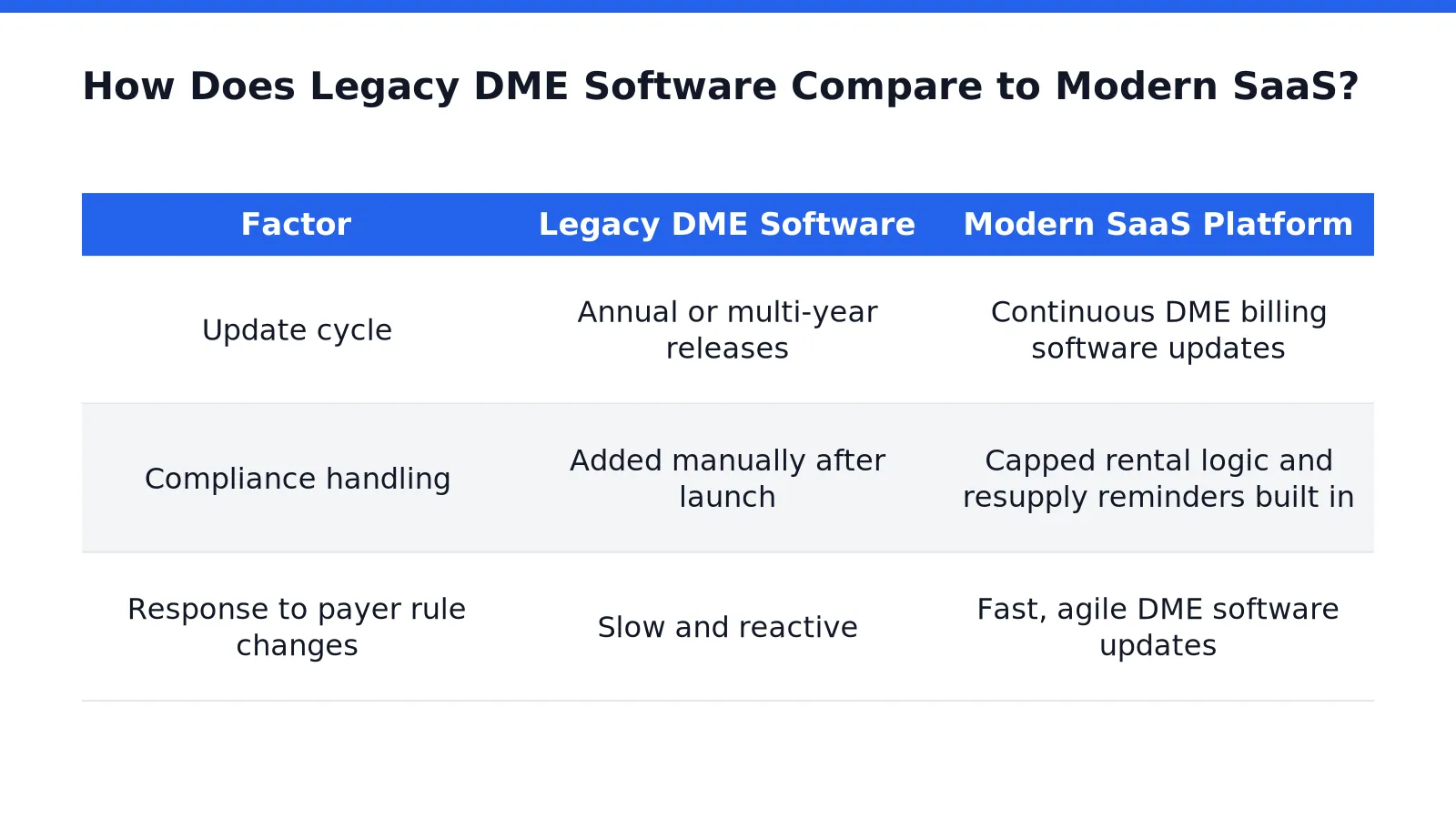
How Does Legacy DME Software Compare to Modern SaaS?
Legacy DME systems lock providers into slow update cycles. Modern SaaS platforms deliver continuous improvements that match evolving payer rules. DME providers must track rental cycles, chase prior authorizations, and match HCPCS codes to certificates of medical necessity with exact precision. Outdated platforms rarely receive fast enough updates to keep pace with these shifting requirements.
Legacy vendors may struggle to integrate compliance features into systems that were not originally designed for capped rental logic or resupply tracking. Modern SaaS providers build those features into core workflows from the start, treating compliance as foundational rather than optional. This shift reflects modern HME software development. Product teams ship through rapid iteration in HME software instead of waiting for annual release cycles.
| Factor | Legacy DME Software | Modern SaaS Platform |
|---|---|---|
| Update cycle | Annual or multi-year releases | Continuous DME billing software updates |
| Compliance handling | Added manually after launch | Capped rental logic and resupply reminders built in |
| Response to payer rule changes | Slow and reactive | Fast, agile DME software updates |
Why Do DME Billing Software Updates Matter for Compliance?
Filing claims without a current system feels like navigating dense fog for providers still running outdated software. Implementing and maintaining billing software sits at the center of running a DME business. It turns into the most frustrating part when vendors stop improving the platform. Operators stuck waiting on fixes often learn about missing modifiers and denials weeks after equipment already left the warehouse.
BFLOW product updates follow a different philosophy, shipping improvements based on direct operator feedback rather than a fixed annual roadmap. The real divide between legacy DME software and modern SaaS lies in their responsiveness. One model waits for the next scheduled release; the other adapts as payer requirements change, closing the gap between a support ticket and a working fix.

What Does Rapid Iteration Look Like in Practice?
Rapid iteration in HME software means a billing director submits a workflow complaint and sees a platform response measured in weeks, not years. For HME and DME operators still tethered to legacy systems, that gap defines the daily frustration: tickets sit open, bugs persist through multiple claim cycles, and nobody at the vendor seems accountable. BFLOW product updates follow a different model, built around the idea that a billing platform should evolve alongside payer rules and operational demands rather than sit frozen until a costly version upgrade.
The foundation is structural. BFLOW unifies intake, billing, inventory, and day-to-day workflow into a single cloud-based system, which means a fix or enhancement in one module doesn't require a separate patch cycle for every connected piece. Because intake, billing, revenue cycle management, and profitability intelligence already live on one platform, agile DME software updates touch the whole operation at once instead of trickling out module by module over months.
Why does update speed matter for DME billing accuracy?
Claims denied over missing modifiers or outdated HCPCS mappings cost providers real revenue every week they go unresolved. A platform built for modern HME software development closes that exposure faster. Compliance logic updates centrally rather than waiting on a disconnected legacy codebase.
Coverage matters too. BFLOW spans intake, billing, inventory, point of sale, delivery, and RCM for any U.S. payer, so updates address the full claim lifecycle rather than a single isolated function.
| Legacy DME software | Modern SaaS approach |
|---|---|
| Slow, infrequent release cycles | Continuous, incremental releases |
| Siloed modules, isolated fixes | Unified platform-wide updates |
| Opaque automation | AI-assisted, human-checked logic |
That last distinction, keeping AI-driven automation human-checked rather than hidden, is what separates legacy DME software vs modern SaaS platforms still asking providers to trust a black box.

Who Benefits Most, And Who Should Pause?
HME operators handling delivery, setup, service, and resupply over years of patient relationships benefit most from software that evolves at the same pace as their service model. Durable medical equipment suppliers face strict, item-specific coverage policy, so billing logic needs constant adjustment as payer rules shift around each HCPCS code and certificate of medical necessity. Providers who treat their platform as a background utility, rather than a lever for competitive advantage, carry the greatest exposure when a vendor stops responding to tickets.
Modern HME software development rewards operators running intake, prescriptions, worklists, inventory, reporting, and workforce operations inside one connected system. Those teams gain the most when BFLOW product updates keep arriving instead of stalling for months at a time.
Who should pause before switching platforms?
Operators mid-cycle on a major rollout, with staff still learning a new system, should weigh timing carefully before adding another transition. A pause makes sense when internal training, not vendor neglect, is the bottleneck. Legacy DME software vs modern SaaS comparisons matter less if the current rollout simply needs more runway.
Does rapid iteration fit every DME or HME business size?
Smaller operators with narrow billing categories sometimes see less daily impact from rapid iteration in HME software than multi-location providers juggling varied payer rules.
| Operator Profile | Best Fit For |
|---|---|
| Multi-location HME provider | DME billing software updates tied to shifting item-specific coverage |
| Single-service DME supplier | Stable platform with steady, lower-frequency releases |
| Growth-stage provider | Agile DME software updates that scale with new service lines |
| Mid-rollout operator | Pausing new platform evaluation until training stabilizes |
Readers managing complex HCPCS coding and rental cycles stand to lose the most ground on a stagnant system; those in a stable, narrow workflow face lower urgency.
Is BFLOW the Right Fit for Your Update Needs?
BFLOW fits operators who need a platform built exclusively for durable and home medical equipment providers, not a generalized billing tool retrofitted for the industry. The platform exists as an all-in-one cloud system covering intake, billing, inventory, and reporting under one roof. Providers stuck comparing legacy DME software vs modern SaaS often find the gap widens every quarter they wait. Compliance rules and payer requirements keep moving while static systems stand still.
Reliability and innovation sit at the center of BFLOW's design. The platform fuses current technology with tailored services aimed at keeping operations seamless and compliant, rather than treating compliance as an afterthought bolted onto an aging codebase. That combination matters most for intake managers and billing directors who need rapid iteration in HME software instead of static features frozen in place for years.
Does BFLOW Keep Pace With Changing Payer Rules?
HCPCS coding, rental and purchase billing cycles, and payer-specific documentation change constantly, not once and done. A platform built for modern HME software development treats these as evolving requirements, not fixed checkboxes. BFLOW's focus on real-time visibility across intake, claims, collections, and reporting directly targets the areas where slow vendor updates cause the most financial damage.
What Does Agile Development Mean for Providers?
Agile DME software updates and consistent BFLOW product updates give operators a system that adapts alongside regulatory change. Providers evaluating DME billing software updates should weigh how often a vendor ships fixes versus how long tickets sit unresolved.
Conclusion
In closing, rapid software iteration stands as a non-negotiable operational requirement for DME and HME providers navigating an increasingly complex regulatory and competitive landscape. Organizations that embrace continuous platform evolution, through automated workflows, real-time visibility, and compliance-driven updates, establish sustainable competitive advantage while reducing administrative burden. The providers who prioritize agile, purpose-built billing systems position themselves to scale confidently, optimize revenue cycles, and maintain operational excellence as industry demands shift.